SpaceX’s Valuation Soars to $2.6 Trillion, Briefly Outpacing Amazon
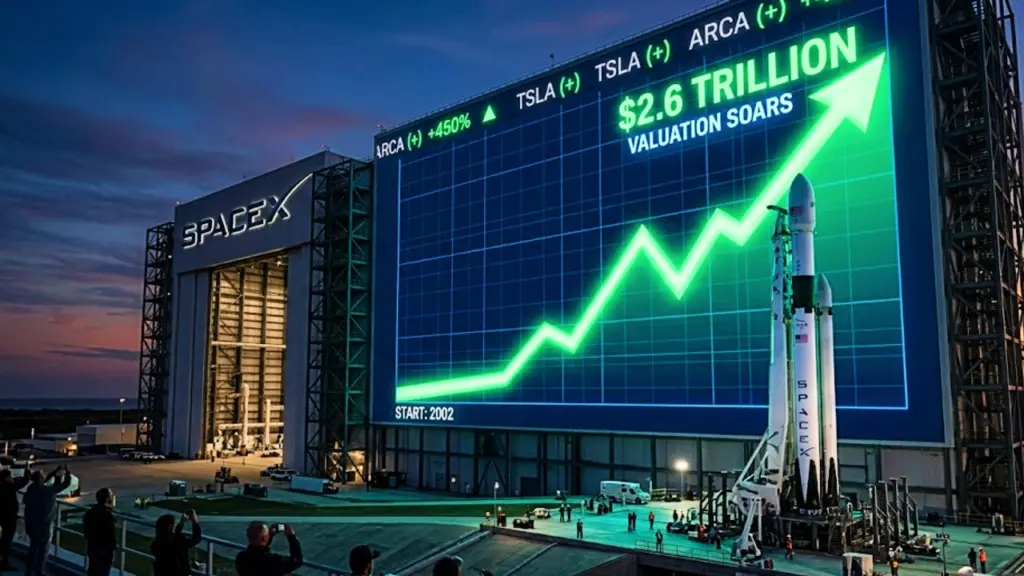
SpaceX Valuation Hits $2.6 Trillion, Briefly Surpassing Amazon
SpaceX, the private aerospace company founded by Elon Musk, has reportedly achieved a staggering valuation of $2.6 trillion during a recent private funding round. This valuation, as reported by TechCrunch, briefly saw SpaceX surpass the market capitalization of established tech giant Amazon. While private valuations are notoriously fluid and subject to change with each funding round, this figure underscores the significant investor appetite for SpaceX’s long-term vision.
The astronomical valuation is a testament to SpaceX’s consistent progress in achieving ambitious goals that were once confined to science fiction. From revolutionizing satellite internet with Starlink to successfully launching astronauts to the International Space Station and developing the Starship vehicle for deep space exploration, the company has demonstrated a capacity for innovation and execution that has captured the imagination of investors.
Quick Take
SpaceX’s valuation has reportedly ballooned to $2.6 trillion, a private market assessment that briefly eclipsed Amazon’s public market value. This surge reflects intense investor belief in SpaceX’s transformative potential across satellite communications, space exploration, and future interplanetary endeavors.
What This Means
This valuation jump signifies more than just a financial metric; it represents a powerful endorsement of SpaceX’s disruptive approach to multiple industries. The company’s success in lowering launch costs with reusable rockets has already reshaped the satellite industry. Starlink, its ambitious satellite internet constellation, continues to expand its global coverage, promising to bring high-speed internet to underserved regions.
Furthermore, the ongoing development of Starship, a fully reusable super heavy-lift launch vehicle, is central to SpaceX’s ultimate goal of making humanity a multi-planetary species.
The comparison to Amazon, a company that has fundamentally altered retail and cloud computing, is noteworthy. While Amazon operates a vast and diversified business with tangible, ongoing revenue streams from e-commerce and AWS, SpaceX’s valuation is heavily weighted towards its future potential and its ability to create entirely new markets. This suggests that investors are betting on SpaceX’s capacity to not only succeed but to redefine industries and establish unprecedented revenue streams in the coming decades.
Why It Matters
For the broader technology and investment world, SpaceX’s valuation trajectory is a significant indicator of where capital is flowing and what future technologies are deemed most promising. It highlights a growing trend of significant investment in deep technology and ambitious, long-term projects that require substantial capital and a long-term vision. This contrasts with the more immediate returns often sought in other tech sectors.
SpaceX’s achievements also have geopolitical and economic implications. Its dominance in the launch market can influence national security capabilities and the economics of space-based industries. The success of Starlink could bridge digital divides, impacting education, commerce, and communication globally. The pursuit of Mars colonization, while seemingly distant, drives innovation in life support, propulsion, and materials science, with potential spin-offs for terrestrial applications.
The comparison with Amazon is also instructive. Amazon’s valuation is built on a proven, albeit rapidly evolving, business model. SpaceX’s valuation, by contrast, is largely predicated on its ability to execute on a series of highly complex, capital-intensive, and technically challenging future endeavors. This divergence in valuation drivers — established revenue versus future potential — is a key point of analysis for understanding the current investment climate in transformative technologies.
Practical Impact for Readers
While most individuals won’t directly invest in SpaceX’s private funding rounds, the company’s progress has tangible impacts. For consumers, Starlink offers an alternative for internet access in remote areas. For businesses, the increasing affordability and reliability of launches enabled by SpaceX are lowering the barrier to entry for satellite deployment, potentially leading to more innovative services in areas like Earth observation, precision agriculture, and advanced telecommunications.
For aspiring engineers and scientists, SpaceX serves as a powerful example of what can be achieved with focused innovation and ambitious goals. Its success story fuels interest in STEM fields and encourages a more daring approach to problem-solving in complex domains. The company’s continued expansion also creates high-skill job opportunities in aerospace, software engineering, and manufacturing.
Limitations, Risks, and Unanswered Questions
It is crucial to approach private company valuations with a degree of skepticism. A $2.6 trillion valuation is an estimate derived from private transactions and is not subject to the same public scrutiny and daily fluctuations as a publicly traded company’s market capitalization. The actual liquidity and realizable value for investors can differ significantly.
Several key questions remain. How will SpaceX continue to fund its incredibly ambitious long-term projects, particularly the development of Starship and a potential Mars colony? What are the regulatory hurdles and geopolitical challenges associated with its expanding satellite constellations and space ambitions? Furthermore, how will SpaceX navigate the increasing competition in the commercial space sector?
The long-term profitability and sustainability of SpaceX’s various ventures are still largely theoretical. While Starlink is generating revenue, its profitability in the face of significant infrastructure costs and competition is an ongoing concern. The success of Starship and its role in future revenue generation is entirely dependent on its technical viability and operational success.
The comparison to Amazon, while illustrative, should not obscure the fundamental differences in their business models and revenue generation strategies.
Key Facts
- SpaceX’s valuation reportedly reached $2.6 trillion in a recent private funding round.
- This valuation briefly surpassed Amazon’s market capitalization.
- SpaceX is known for its reusable rocket technology, Starlink satellite internet, and Starship development.
- The company aims for ambitious long-term goals, including human spaceflight and Mars colonization.
- Private company valuations can be highly variable and are not subject to the same real-time market forces as public companies.
Frequently Asked Questions
What is SpaceX’s current valuation?
SpaceX’s valuation was reported to be $2.6 trillion in a recent private funding round, though this figure is an estimate and can fluctuate.
Did SpaceX briefly pass Amazon in valuation?
Yes, according to reports, SpaceX’s valuation of $2.6 trillion briefly exceeded Amazon’s market capitalization.
How does SpaceX make money?
SpaceX generates revenue primarily through its launch services for satellites and government missions, and increasingly through its Starlink satellite internet service. Future revenue streams are anticipated from Starship operations and potential lunar/Martian activities.
Is SpaceX a public company?
No, SpaceX is a privately held company, meaning its shares are not traded on public stock exchanges.
Leave a Reply