NVIDIA’s BioNeMo Agent Toolkit: AI Agents Get Serious About Scientific Discovery
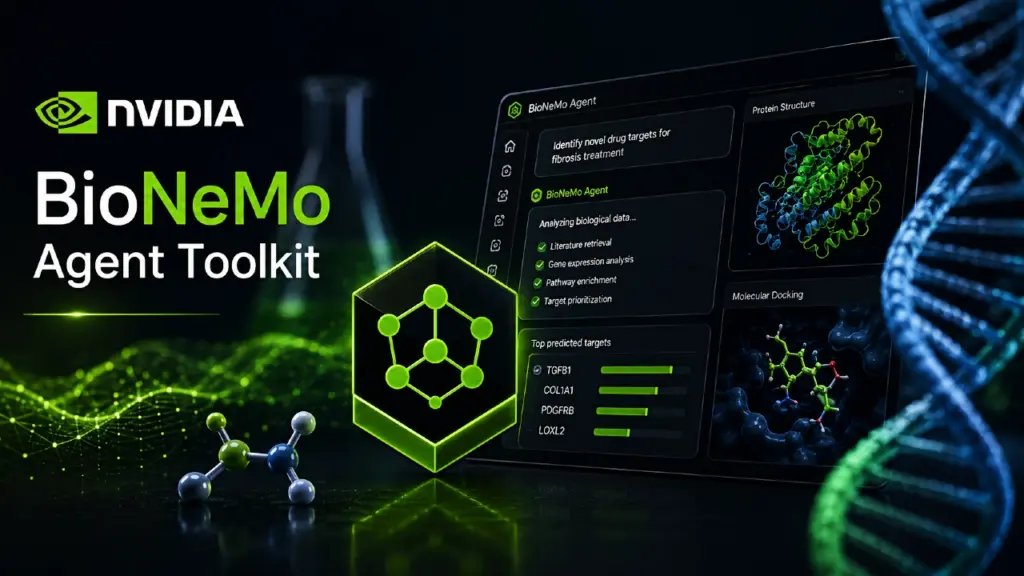
NVIDIA, a company whose name has become almost synonymous with the current AI boom, has announced a new suite of tools designed to push AI further into the realm of scientific research. The BioNeMo Agent Toolkit is NVIDIA’s latest move to provide specialized infrastructure for AI development, this time focusing on enabling AI agents to accelerate scientific discovery.
This isn’t just another general-purpose AI model; it’s about giving AI agents the building blocks and operational frameworks to tackle complex scientific problems.
Quick Take
NVIDIA’s BioNeMo Agent Toolkit offers specialized AI capabilities for scientific discovery. By providing tools for AI agents to interact with data, models, and scientific workflows, NVIDIA aims to significantly speed up research in areas like drug discovery and materials science. While promising, the real-world impact will depend on adoption, integration, and the ongoing evolution of AI’s role in scientific methodology.
What This Means
At its core, the BioNeMo Agent Toolkit is designed to empower AI agents. Think of these agents not as simple chatbots, but as sophisticated digital assistants capable of performing complex tasks. The toolkit provides these agents with the ability to understand and interact with scientific data, leverage large language models (LLMs) tailored for scientific domains, and integrate with existing scientific software and hardware.
The goal is to create AI systems that can actively participate in the scientific process – from hypothesis generation and experimental design to data analysis and even the prediction of molecular properties.
NVIDIA’s announcement highlights the potential for these AI agents to accelerate research in areas critical to human well-being, such as drug discovery and development. By automating repetitive tasks, analyzing vast datasets more efficiently, and identifying patterns that might elude human researchers, these tools could drastically shorten the time it takes to bring new therapies to market or discover novel materials with specific properties.
The toolkit is built upon NVIDIA’s existing AI infrastructure, including its DGX Cloud and AI Enterprise software, suggesting a commitment to providing a comprehensive ecosystem for AI in science.
Why It Matters
The significance of the BioNeMo Agent Toolkit lies in its specialized focus. While general AI models have shown impressive capabilities, scientific research often demands a level of precision, domain expertise, and integration with specific workflows that generic AI struggles to provide. NVIDIA’s approach recognizes that accelerating scientific discovery requires more than just powerful computation; it requires AI that is deeply embedded within the scientific method.
By providing agents with the ability to reason, plan, and execute tasks within a scientific context, NVIDIA is essentially aiming to create AI collaborators for scientists. This could democratize access to advanced research capabilities, allowing smaller labs or researchers with limited computational resources to leverage sophisticated AI tools. Furthermore, it could help overcome bottlenecks in areas where human expertise is scarce or where the sheer volume of data is overwhelming.
The potential for faster drug discovery is particularly noteworthy. The traditional drug development pipeline is notoriously long, expensive, and has a high failure rate. AI agents equipped with tools like BioNeMo could sift through vast chemical libraries, predict the efficacy and toxicity of potential drug candidates, and even optimize experimental protocols, potentially saving years and billions of dollars in research and development costs.
Similarly, in materials science, AI could accelerate the discovery of new materials with desired characteristics for applications ranging from renewable energy to advanced electronics.
Practical Impact for Readers
For researchers in the life sciences, chemistry, and materials science, the BioNeMo Agent Toolkit represents a new set of powerful tools that could streamline their work and open up new avenues of inquiry. It suggests a future where AI agents are not just passive tools for analysis but active participants in the research lifecycle. Companies and institutions investing in AI for R&D will likely find this toolkit a valuable component of their AI strategy, potentially leading to faster innovation and a competitive edge.
For the broader public, the implications are equally significant. Accelerated scientific discovery means faster development of new medicines, advanced materials, and solutions to pressing global challenges like climate change. While direct interaction with the toolkit might be limited to specialists, its impact will be felt through the innovations it helps to create.
Limitations and Unanswered Questions
While the announcement is promising, several questions remain. The true effectiveness of the BioNeMo Agent Toolkit will depend on its ease of integration with diverse existing scientific software and hardware. Scientific research is often a bespoke process, and a toolkit’s success hinges on its adaptability to unique workflows. Details on the specific scientific domains the toolkit is initially optimized for, beyond general mentions of drug discovery and materials science, would also be beneficial.
Furthermore, the reliability and interpretability of AI-driven scientific conclusions are paramount. While AI can identify patterns, scientists still need to validate these findings through rigorous experimentation. The toolkit’s ability to facilitate this validation process, and to provide clear explanations for its AI-generated insights, will be crucial for its adoption.
As with any powerful AI tool, ethical considerations regarding data privacy, intellectual property, and the potential for bias in AI-driven research will also need careful attention as these technologies mature.
The announcement also doesn’t provide specific timelines for availability or details on pricing, which are critical factors for adoption by research institutions and companies. The long-term maintenance and evolution of the toolkit, especially in the rapidly changing field of AI, will also be a key consideration for users.
Frequently Asked Questions
What is the NVIDIA BioNeMo Agent Toolkit?
The NVIDIA BioNeMo Agent Toolkit is a suite of tools designed to empower AI agents to accelerate scientific discovery, particularly in fields like drug discovery and materials science. It provides agents with the capabilities to interact with scientific data, leverage domain-specific AI models, and integrate with scientific workflows.
How can AI agents accelerate scientific discovery?
AI agents can accelerate scientific discovery by automating complex tasks, analyzing large datasets more efficiently, identifying subtle patterns, generating hypotheses, and assisting in experimental design. This can significantly reduce the time and cost associated with traditional research methods.
What are the potential applications of the BioNeMo Agent Toolkit?
Potential applications include speeding up drug discovery and development by identifying promising drug candidates and optimizing clinical trials, as well as accelerating the discovery of new materials with specific properties for various industries.
What are the limitations of AI in scientific research?
Limitations include the need for rigorous human validation of AI-generated findings, challenges in integrating AI with diverse and often bespoke scientific workflows, ensuring the interpretability of AI insights, and addressing ethical considerations such as data privacy and bias.
Leave a Reply