Samsung’s UFS 5.0: Faster Storage is Coming to Your Next Phone
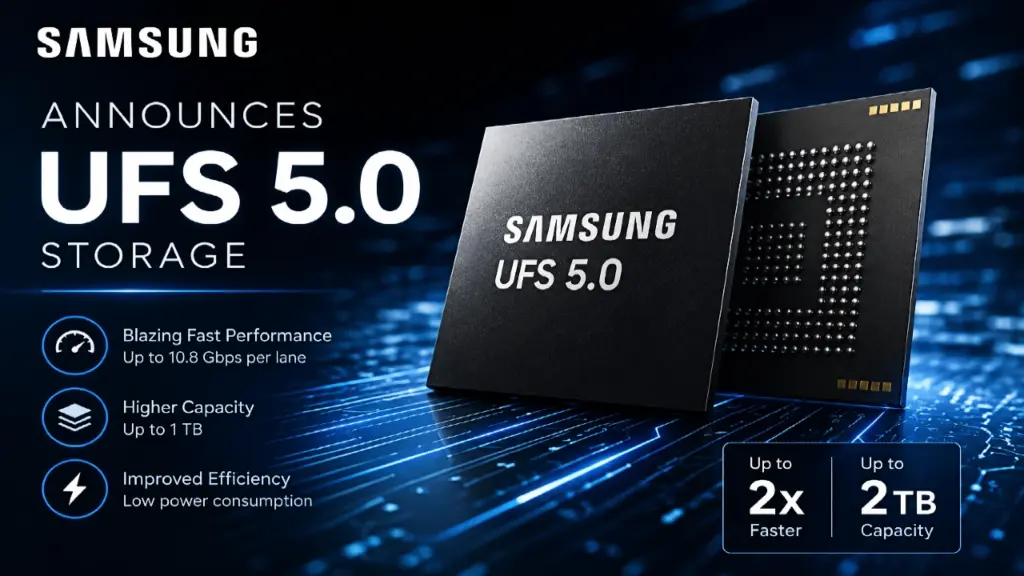
Samsung Announces UFS 5.0 Storage
Samsung has officially announced the development of its next-generation Universal Flash Storage (UFS) 5.0 standard. This move signals a significant upgrade in the speed and efficiency of storage solutions for mobile devices, with the company touting performance improvements that could fundamentally change how we interact with our smartphones.
According to Samsung, UFS 5.0 is engineered to deliver up to twice the performance compared to the current UFS 4.1. This isn’t just a minor bump; it represents a substantial leap in sequential read and write speeds. The new standard is set to achieve sequential read speeds of up to 10.8GB/s and sequential write speeds of up to 9.8GB/s. These figures are based on the JEDEC’s latest embedded storage interface specification, the industry body that sets standards for memory and storage technologies.
Quick Take
Samsung’s UFS 5.0 promises a doubling of storage performance for smartphones, crucial for handling increasingly complex AI tasks and large datasets directly on devices. While the exact timeline for consumer devices remains unconfirmed, this advancement sets the stage for faster, more responsive mobile experiences.
What This Means for Your Next Phone
The implications of UFS 5.0 are far-reaching, especially in the context of modern smartphone capabilities. One of the most highlighted benefits is its potential to enhance on-device artificial intelligence. As smartphones become more capable of running sophisticated AI models, such as large language models (LLMs), the speed at which data can be accessed and processed becomes a critical bottleneck.
Samsung states that UFS 5.0 will help reduce latency and improve response times for these AI applications. Imagine AI assistants that respond instantaneously, or on-device photo editing that feels as fluid as a desktop application.
Beyond AI, faster storage means quicker app loading times, faster file transfers (both saving photos and downloading content), and a generally snappier user experience. For tasks that involve large files, like editing 4K video on your phone or transferring massive game downloads, UFS 5.0 could make a noticeable difference.
This development also aligns with the broader trend of mobile devices taking on more computational tasks that were once to PCs. Faster storage is a fundamental component in enabling this shift, allowing devices to handle more data locally and efficiently.
Why It Matters: Beyond the Numbers
While the raw speed increase is impressive, the real story here is how this technology supports the evolving demands of mobile computing. The push towards on-device AI is a significant trend. Relying solely on cloud-based AI processing introduces latency and privacy concerns. By enabling more powerful AI to run directly on the device, UFS 5.0 can contribute to more private, faster, and potentially more reliable AI experiences.
This is particularly relevant when considering the increasing complexity of generative AI and its potential applications in everything from personalized content creation to advanced accessibility features.
Furthermore, the standardization by JEDEC means this isn’t just a proprietary Samsung technology; it’s an industry direction. This suggests that other manufacturers will likely adopt UFS 5.0 or similar standards in their future devices, leading to a more uniform improvement across the smartphone market. This is a welcome change from the often fragmented adoption of new technologies.
For consumers, this means that the devices they buy in the coming years will be better equipped to handle the software and features that are being developed today. It’s an investment in future-proofing, ensuring that your smartphone remains capable for longer.
Practical Impact for Readers
What does this mean for you, the user? If you’re in the market for a new smartphone within the next year or two, you can expect devices to feel significantly faster, especially when dealing with demanding applications or AI-driven features. App installations and updates might take less time. Saving large photos or videos will be quicker. If you’re a mobile gamer, game loading times could see an improvement.
For those interested in the emerging AI capabilities on phones, UFS 5.0 is a key enabler that will make these features more responsive and useful.
Consider the example of Samsung’s own foldable phones, which often push the boundaries of mobile technology. As these devices become more powerful and versatile, faster storage like UFS 5.0 becomes essential to delivering a premium experience. Samsung’s foldable fire sale might offer a glimpse into future hardware needs, and UFS 5.0 is poised to meet them.
Limitations and Unanswered Questions
While the announcement is exciting, Samsung has not yet provided a specific timeline for when devices featuring UFS 5.0 storage will become available. This means that while the technology is ready, its integration into consumer products is still pending. The actual real-world performance will also depend on how device manufacturers implement the UFS 5.0 controller and how well it’s integrated with the phone’s overall system architecture.
It’s also important to remember that storage speed is just one component of overall device performance. The CPU, GPU, RAM, and software optimization all play crucial roles. While UFS 5.0 will undoubtedly improve storage-related tasks, it won’t magically fix all performance issues if other components are lacking.
Finally, the cost implications are yet to be seen. Faster storage often comes with a higher price tag, which could influence the adoption rate of UFS 5.0, especially in mid-range or budget devices. It remains to be clarified whether UFS 5.0 will be to flagship models initially or if it will trickle down to more affordable segments.
Frequently Asked Questions
What is UFS 5.0?
UFS 5.0 is the next-generation Universal Flash Storage standard developed by Samsung, based on JEDEC specifications, offering significantly higher read and write speeds compared to previous generations.
How much faster is UFS 5.0 than UFS 4.1?
Samsung claims UFS 5.0 can deliver up to twice the performance of UFS 4.1, with sequential read speeds of up to 10.8GB/s and sequential write speeds of up to 9.8GB/s.
When will UFS 5.0 be available in phones?
Samsung has announced the development of UFS 5.0, but has not yet provided a specific timeline for its integration into consumer devices.
What are the benefits of UFS 5.0?
The primary benefits include significantly faster data transfer speeds, reduced latency, and improved response times, particularly for on-device AI tasks like large language models (LLMs).
Sources Used
- Samsung announces UFS 5.0 storage, and it may be in your next phone
Leave a Reply